Data indicates that:
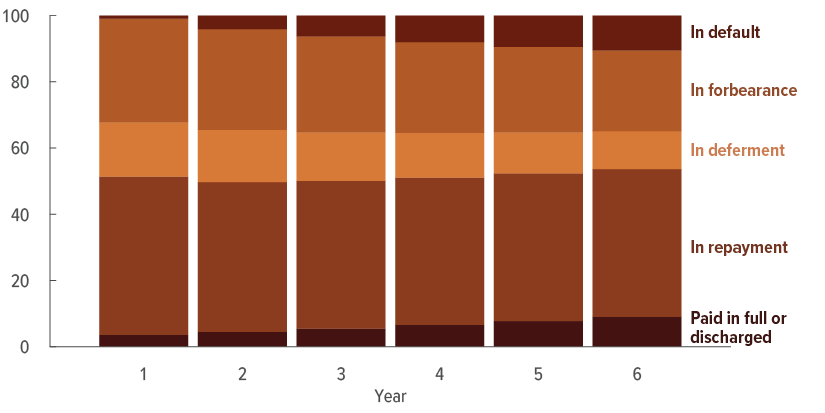
- 70% of students have education debt at the end of their undergraduate studies
- 2 out of 5 loans were in financial distress within six years of issuance
That means that 28% (or 70% * 40%) of student-borrowers will face financial distress and should therefore a priori understand their options.
Why Relying on Corporations or the Federal Government Might Be a Mistake
Can you have blind faith in large institutions?
Navient, the loan servicer of 12 million accounts, was split from Sallie Mae in 2014. 3 years later, the CFPB (Consumer Finance Protection Board) and the Attorney General of several states initiated a suit alleging that Navient misled student loan borrowers about IDR (income-driven repayment) plans, forbearance, credit score impact, payment processing and co-signer release requirements, among other things. Navient settled with the agencies and legal authorities, agreeing to:
- Cancel $1.7 billion on 66,000 student loans with several states’ Attorney General
- $120 million settlement with the CFPB
- Be permanently banned from servicing federal student loans
Can students expect the Federal government to protect or advocate for them?
As Presidents change, goals and priorities may likewise shift at regulatory agencies. When Joe Biden was President, the DOE (Department of Education) attempted to discharge 205,000 student loans based upon claims of fraud against their school. The DOE headed by Linda McMahon, appointed by Trump, attempted to forestall relief. The courts recently ruled in favor of student class. The courts rejected the DOE attempt to prevent loan forgiveness in the Sweet v. McMahon case.
Forbearance Could Provide Relief for Borrowers Under Stress
Student loan forbearance is a temporary postponement or reduction of student loan payments due to financial difficulty. Forbearance can last twelve months for federal loans and are typically 3-6 months for private loans. Issues that would produce qualification for this program could be:
- Financial difficulty
- Medical limitations or expense
- Change in employment
- Policy related employment, such as AmeriCorps, teaching, medical internship
Loans continue to accrue interest, even when deferment is granted. Arrangements can be made for at least interest-only payments, avoiding the accretion of interest to principal.
Other Loan Dispensation Programs
In addition to forbearance, other loan dispensation programs include:
- FFEL (Federal Family Education Loan) offered reduced interest rates for consecutive timely payment. Say, 1% off the contracted rate with 12 months of timely payment – this is an example only.
- PSFL (Public Service Loan Forgiveness) offered graduated loan forgiveness to full-time federal, state, local or tribal employees.
- IDR forgiveness was possible on loans with 20+ years of payment that were still outstanding.
For borrowers who do not work for any public sector employer, FFEL or PSFL might be unattainable. Another option might be consolidation.
Is Student Loan Consolidation Your Best Option?
Consolidation involves combining multiple loans balances and blending the associated rates.
| Loan A | Loan B | Combined Loans | |
| Amount | $10,000 | $5,000 | $15,000 (a, b, c) |
| Interest Rate | 8% | 6% | 7.33% (d) |
| Term | 10 years | 6 years | 8 years 8 months (e) |
| Monthly Payment | $121.33 | $82.86 | $204.19 |
- $10,000 (loan A) + $5,000 (loan B) = $15,000 (combined)
- Loan A consolidation weight = 10,000 / 15,000 = 2/3
- Loan B consolidation weight = 5,000 / 15,000 = 1/3
- 2/3 * 8% + 1/3 * 6% = 5.33% + 2% or 7.33%
- 2/3 * 10 years loan A + 1/3 * 6 years loan B = 8.67 years
The interest rate on consolidated loan is rounded up to the nearest one-eighth of one percent. The combined loan would be $15,000 @ 7.375% instead of 7.33%, or 45 additional basis points. This administrative simplification of making one payment a month instead of two may benefit some. The revised payments are shown below in a few scenarios:
|
Loan |
A | B | Consolidated
Statutory |
Consolidated
Shorter Term |
Consolidated
Lower Pay |
|
Interest |
8.00% | 6.00% | 7.375% | 7.375% | 7.375% |
|
Term – years |
10 | 6 | 8.67 | 6 |
10 |
|
Borrowed |
$10,000 | $5,000 | $15,000 | $15,000 |
$15,000 |
| Months 1 – 72 |
$121.33 |
$82.86 | $195.63 | $258.44 |
$177.08 |
|
Months 73 – 104 |
$121.33 | – | $195.63 | – |
$177.08 |
|
Months 105-120 |
$121.33 | – | 4195.63 | – |
$177.08 |
| Total Paid | $14,559 | $5,966 | $20,345 | $18,608 |
$21,249 |
From the table above, we see the loans under their original terms have a total pay back in nominal terms of $20,525 (that is the total paid under column A + column B). Under the original scenario, a combined $204.19 is paid per month for the first six years. After six years, Loan B is paid off; Loan A has a remaining four years of monthly payment at $82.86. From the table above, we see the loans under their original terms have a total pay back of $20,525 (that is the total paid under column A + column B).
The consolidated loan could have a term longer, shorter or equal to the weighted term of the previous loans. Accordingly, monthly payments could be higher, lower or the same. Comparing the last two columns, if the borrower can repay $258 per month, the loan could be satisfied in 6 years. With monthly payments of $177, the loan term would be 10 years. Approximately $2,600 additional interest accrues for the four extra years.
What may be more critical is certain loan benefits previously attained may be forfeited. Benefits on individual loans could be forfeited on the consolidated loan. You don’t have to consolidate all your loans. Depending on your specific situation, you could choose to exclude federal student loans that qualify for, say FFEL or PSFL, in any consolidation combination.
The details for individual debtors vary. These nuances preclude the notion of “one size fits all”. This content is not meant as specific legal or financial advice. Rather, it is meant to illuminate some topics and spark further inquiry.
Each borrower should ask detailed questions to fully understand the before and after implications of different scenarios.
- What will my monthly payments be?
- How long are payments required before satisfying debt?
- What will be the total interest paid over the life of the loan?
- How will the new terms impact my credit score or debt capacity?
Your student loan holder should be able to answer many of the questions. Do not rely on a single source for information. Take the opportunity to compare information from multiple sources to gauge accuracy and completeness.
If you have discretionary funds, you may want to consider saving interest cost or hastening the life of your loans by paying off the most expensive loans first. Include specific instructions to apply the additional payment to the principal so that lending institutions do not instead allocate it towards future payments.
Make Student Loans a Funding Source of Last Resort
Taking a student loan should be considered after other less costly options are considered. FAFSA forms should be completed to estimate financial aid. Scholarship opportunities need to be identified and pursued.
Families should compare tuition, room and board at comparable schools and make prudent decisions accordingly. Researching average starting salaries for potential industries can clarify whether the repayment of loans under commercial terms is realistically within reach.
Student loans and other types of debt or liability will impact your credit rating. Avoid delinquency as it will lower your credit score. Occasionally examine (free) credit reports from the major agencies such as Equifax, Experian, and TransUnion. The office of Federal Student Aid (FSA) is another resource to utilize to arm yourself with knowledge and options.
If your friends and family lack expertise, reach out to a financial advisor and continue to read blogs that increase your knowledge and lead you to further questions. Another online resource is studentaid.gov. Be apprised about different repayment plans and then discuss your options with your lender.